

Table of Content
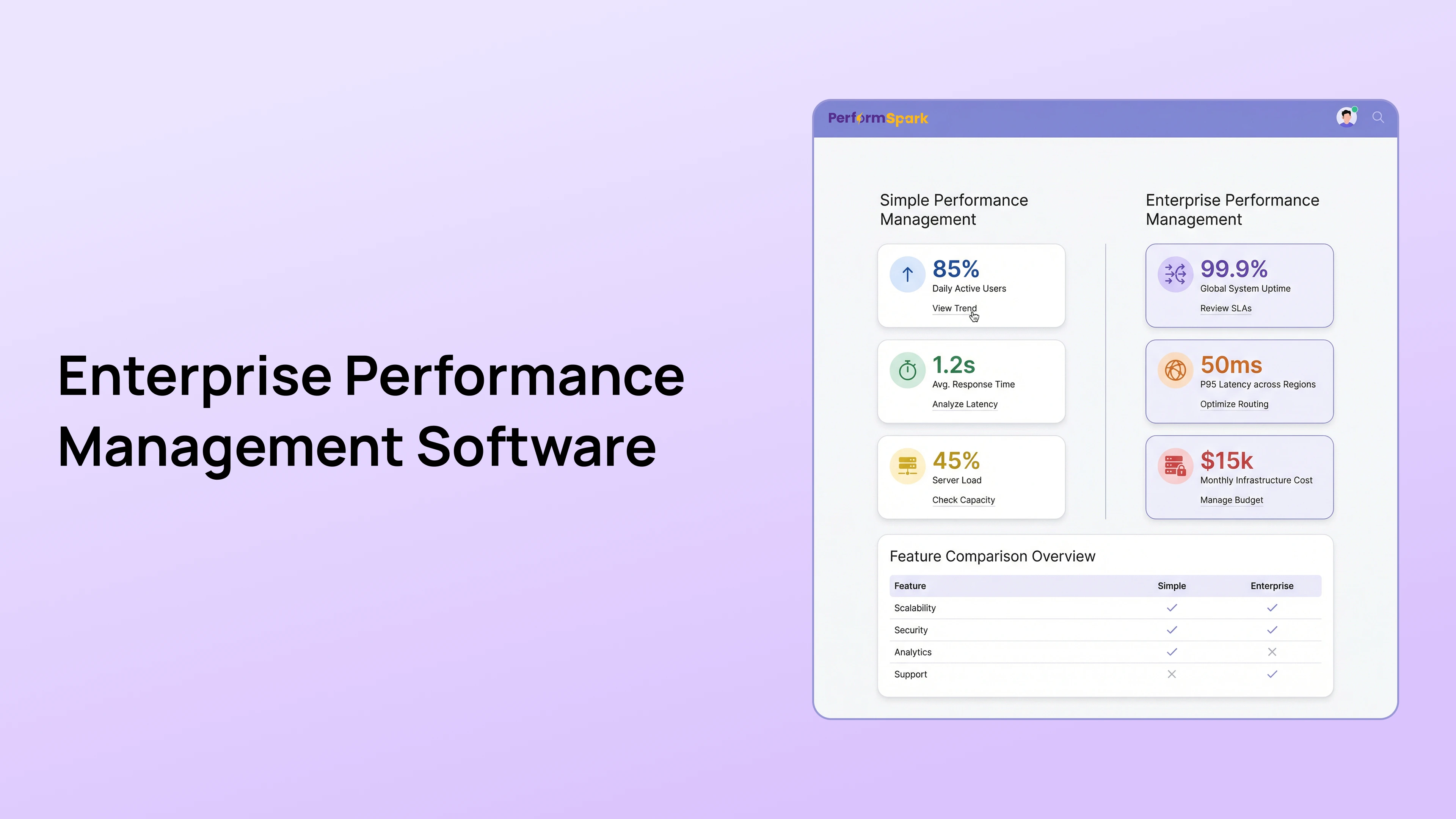
Simple vs. Enterprise Performance Management: What Actually Works for High-Growth Teams?
The most critical decision a CTO or CHRO makes is not who to hire, but what tools to give them.
When buying HR software, leaders usually fall into one of two traps.
Trap 1: The Toy Tool.
They buy a cheap, startup-friendly tool that looks pretty but breaks the moment you hit 50 employees because it lacks data security and permissions.
Trap 2: The Enterprise Monolith.
They buy a massive All-in-One suite like Oracle or Workday. It costs six figures. It takes 9 months to implement. And everyone hates using it because the interface looks like a spreadsheet from 1999.
In the PerformSpark Strategy, we champion the Mid-Market Specialist.
You need software that is powerful enough to handle Performance Calibration but simple enough that managers actually log in.
This guide compares the three categories of software to help you decide what actually works for high-growth teams.
What is the "All-in-One" Suite Trap?
The Enterprise Suite promises to do everything. It handles Payroll, Benefits, ATS, Performance, and Learning in one database. This sounds efficient on paper, but it often fails in practice.
Why do users reject "Jack of All Trades" software?
The Depth Problem:
- Issue: A suite is usually built by acquiring 10 different companies and stitching them together.
- Result: The Performance module is often an afterthought, lacking deep features like 360 Feedback or continuous feedback loops.
The UX Problem:
- Issue: Enterprise software is designed for the Administrator, not the End User.
- Result: It requires 12 clicks to do what should take 2. This friction kills adoption.
The Innovation Problem:
- Issue: Large suites release updates once a year.
- Result: You are stuck with outdated methodology while agile competitors are using modern AI tools like TrAI.
What is the hidden cost of "Bloatware"?
Shelfware Ratio:
- Definition: The percentage of features you pay for but never use.
- Statistic: In enterprise suites, the average customer uses less than 20% of the available features.
Implementation Tax:
- Cost: You often have to hire a third-party consultant just to configure the software.
- Time: Average deployment time is 6 to 12 months.
What is "Simple" software (and when does it break)?
On the other end of the spectrum are simple, standalone tools designed for early-stage startups.
The 50-Employee Ceiling
- The Breaking Point: Simple tools work great for 20 people. They fail at 50.
- Missing RBAC (Role-Based Access Control):
- Risk: Simple tools often lack granular permissions. You cannot hide sensitive compensation data from specific managers.
- Missing Calibration:
- Risk: They treat reviews as simple forms. They lack the 9-Box Grid needed to ensure pay equity across departments.
- Missing Integration:
- Risk: They do not sync with your HRIS, forcing manual data entry every time you hire someone.
The Comparison: Legacy Suite vs. Specialized Modern Tool
To rank for comparison queries, use this direct feature breakdown.
Why "Best-of-Breed" is the new standard for Mid-Market
The modern tech stack strategy is Best-of-Breed. Instead of buying one mediocre suite, you buy the best tool for each specific job and connect them via API.
How does the API Economy solve data silos?
- The Old Fear: We need a suite so all the data is in one place.
- The New Reality: APIs (Application Programming Interfaces) allow data to flow instantly between systems.
The PerformSpark Stack:
- HRIS (The Source of Truth): BambooHR, ADP, or Gusto holds employee demographics.
- Communication (The Flow): Slack or MS Teams handles the Nudge Engine.
- Performance (The Brain): PerformSpark handles Goals, Reviews, and Feedback.
The Result: You get the deep functionality of a specialized tool with the unified data of a suite.
What is the risk of Vendor Lock-in?
- The Suite Trap: If you hate the Performance module in your suite, you cannot switch it out without replacing your entire Payroll system. You are held hostage.
- The Agile Advantage: With Best-of-Breed, you can swap out your Performance tool if your strategy changes, without disrupting Payroll or Benefits. This gives you negotiation power.
How does TrAI bridge the "Enterprise Gap"?
Mid-market companies need enterprise-grade intelligence without enterprise-grade complexity. TrAI delivers this.
Analytics without the Data Scientist
Enterprise Tool: Requires a dedicated analyst to build SQL queries to generate reports.
PerformSpark:
- Natural Language Query: You ask TrAI questions like Show me the top performers in Sales who are at risk of leaving.
- Instant Visualization: The system builds the chart instantly.
Legal Defense without the Lawyers
Enterprise Tool: massive compliance logs that are hard to search.
PerformSpark:
- Bias Scanning: TrAI actively scans PIPs and Reviews for biased language before they are submitted.
- Audit Readiness: One-click export of all feedback history for legal defense.
When should you switch to a Specialized Tool?
There are specific triggers that indicate you have outgrown a spreadsheet or a basic tool, but are not ready for a massive suite.
The 3 Growth Triggers
1. The "Manager Revolt"
- Signal: Managers stop doing reviews because the current process (Google Docs or clunky software) takes too long.
- Action: You need a tool with Flow of Work integration to remove friction.
2. The "Equity Crisis"
- Signal: You realize that different managers are grading differently, causing pay discrepancies.
- Action: You need a tool with built-in Calibration features to normalize ratings.
3. The "Compliance Cliff"
- Signal: You are preparing for a funding round or audit (SOC2) and need proof of performance management.
- Action: You need a system with immutable audit trails and Role-Based Access Control.
Conclusion
When evaluating performance management options, organizations often find themselves choosing between two flawed extremes.
On one end, All-in-One Suites inevitably suffer from feature bloat and poor user experience, which ultimately leads to low adoption rates across the company. On the other end, Simple Tools designed for startups often fail to provide the rigorous security and data depth required to operate at scale.
Specialized Platforms like PerformSpark offer the ideal "Goldilocks" solution by bridging this gap, delivering the robust power of an enterprise system wrapped in the intuitive simplicity of a consumer app.
The Strategic Recommendation:
- Do not buy software based on the number of features on a checklist.
- Buy software based on the Adoption Rate.
- If your managers use it, it works. If they do not, it is just expensive shelfware.
Book a Consultative Demo and see why high-growth teams switch from spreadsheets and suites to PerformSpark.
Simple vs. Enterprise Performance Management: What Actually Works for High-Growth Teams?
The most critical decision a CTO or CHRO makes is not who to hire, but what tools to give them.
When buying HR software, leaders usually fall into one of two traps.
Trap 1: The Toy Tool.
They buy a cheap, startup-friendly tool that looks pretty but breaks the moment you hit 50 employees because it lacks data security and permissions.
Trap 2: The Enterprise Monolith.
They buy a massive All-in-One suite like Oracle or Workday. It costs six figures. It takes 9 months to implement. And everyone hates using it because the interface looks like a spreadsheet from 1999.
In the PerformSpark Strategy, we champion the Mid-Market Specialist.
You need software that is powerful enough to handle Performance Calibration but simple enough that managers actually log in.
This guide compares the three categories of software to help you decide what actually works for high-growth teams.
What is the "All-in-One" Suite Trap?
The Enterprise Suite promises to do everything. It handles Payroll, Benefits, ATS, Performance, and Learning in one database. This sounds efficient on paper, but it often fails in practice.
Why do users reject "Jack of All Trades" software?
The Depth Problem:
- Issue: A suite is usually built by acquiring 10 different companies and stitching them together.
- Result: The Performance module is often an afterthought, lacking deep features like 360 Feedback or continuous feedback loops.
The UX Problem:
- Issue: Enterprise software is designed for the Administrator, not the End User.
- Result: It requires 12 clicks to do what should take 2. This friction kills adoption.
The Innovation Problem:
- Issue: Large suites release updates once a year.
- Result: You are stuck with outdated methodology while agile competitors are using modern AI tools like TrAI.
What is the hidden cost of "Bloatware"?
Shelfware Ratio:
- Definition: The percentage of features you pay for but never use.
- Statistic: In enterprise suites, the average customer uses less than 20% of the available features.
Implementation Tax:
- Cost: You often have to hire a third-party consultant just to configure the software.
- Time: Average deployment time is 6 to 12 months.
What is "Simple" software (and when does it break)?
On the other end of the spectrum are simple, standalone tools designed for early-stage startups.
The 50-Employee Ceiling
- The Breaking Point: Simple tools work great for 20 people. They fail at 50.
- Missing RBAC (Role-Based Access Control):
- Risk: Simple tools often lack granular permissions. You cannot hide sensitive compensation data from specific managers.
- Missing Calibration:
- Risk: They treat reviews as simple forms. They lack the 9-Box Grid needed to ensure pay equity across departments.
- Missing Integration:
- Risk: They do not sync with your HRIS, forcing manual data entry every time you hire someone.
The Comparison: Legacy Suite vs. Specialized Modern Tool
To rank for comparison queries, use this direct feature breakdown.
Why "Best-of-Breed" is the new standard for Mid-Market
The modern tech stack strategy is Best-of-Breed. Instead of buying one mediocre suite, you buy the best tool for each specific job and connect them via API.
How does the API Economy solve data silos?
- The Old Fear: We need a suite so all the data is in one place.
- The New Reality: APIs (Application Programming Interfaces) allow data to flow instantly between systems.
The PerformSpark Stack:
- HRIS (The Source of Truth): BambooHR, ADP, or Gusto holds employee demographics.
- Communication (The Flow): Slack or MS Teams handles the Nudge Engine.
- Performance (The Brain): PerformSpark handles Goals, Reviews, and Feedback.
The Result: You get the deep functionality of a specialized tool with the unified data of a suite.
What is the risk of Vendor Lock-in?
- The Suite Trap: If you hate the Performance module in your suite, you cannot switch it out without replacing your entire Payroll system. You are held hostage.
- The Agile Advantage: With Best-of-Breed, you can swap out your Performance tool if your strategy changes, without disrupting Payroll or Benefits. This gives you negotiation power.
How does TrAI bridge the "Enterprise Gap"?
Mid-market companies need enterprise-grade intelligence without enterprise-grade complexity. TrAI delivers this.
Analytics without the Data Scientist
Enterprise Tool: Requires a dedicated analyst to build SQL queries to generate reports.
PerformSpark:
- Natural Language Query: You ask TrAI questions like Show me the top performers in Sales who are at risk of leaving.
- Instant Visualization: The system builds the chart instantly.
Legal Defense without the Lawyers
Enterprise Tool: massive compliance logs that are hard to search.
PerformSpark:
- Bias Scanning: TrAI actively scans PIPs and Reviews for biased language before they are submitted.
- Audit Readiness: One-click export of all feedback history for legal defense.
When should you switch to a Specialized Tool?
There are specific triggers that indicate you have outgrown a spreadsheet or a basic tool, but are not ready for a massive suite.
The 3 Growth Triggers
1. The "Manager Revolt"
- Signal: Managers stop doing reviews because the current process (Google Docs or clunky software) takes too long.
- Action: You need a tool with Flow of Work integration to remove friction.
2. The "Equity Crisis"
- Signal: You realize that different managers are grading differently, causing pay discrepancies.
- Action: You need a tool with built-in Calibration features to normalize ratings.
3. The "Compliance Cliff"
- Signal: You are preparing for a funding round or audit (SOC2) and need proof of performance management.
- Action: You need a system with immutable audit trails and Role-Based Access Control.
Conclusion
When evaluating performance management options, organizations often find themselves choosing between two flawed extremes.
On one end, All-in-One Suites inevitably suffer from feature bloat and poor user experience, which ultimately leads to low adoption rates across the company. On the other end, Simple Tools designed for startups often fail to provide the rigorous security and data depth required to operate at scale.
Specialized Platforms like PerformSpark offer the ideal "Goldilocks" solution by bridging this gap, delivering the robust power of an enterprise system wrapped in the intuitive simplicity of a consumer app.
The Strategic Recommendation:
- Do not buy software based on the number of features on a checklist.
- Buy software based on the Adoption Rate.
- If your managers use it, it works. If they do not, it is just expensive shelfware.
Book a Consultative Demo and see why high-growth teams switch from spreadsheets and suites to PerformSpark.




.svg)

.svg)
.svg)