

Table of Content
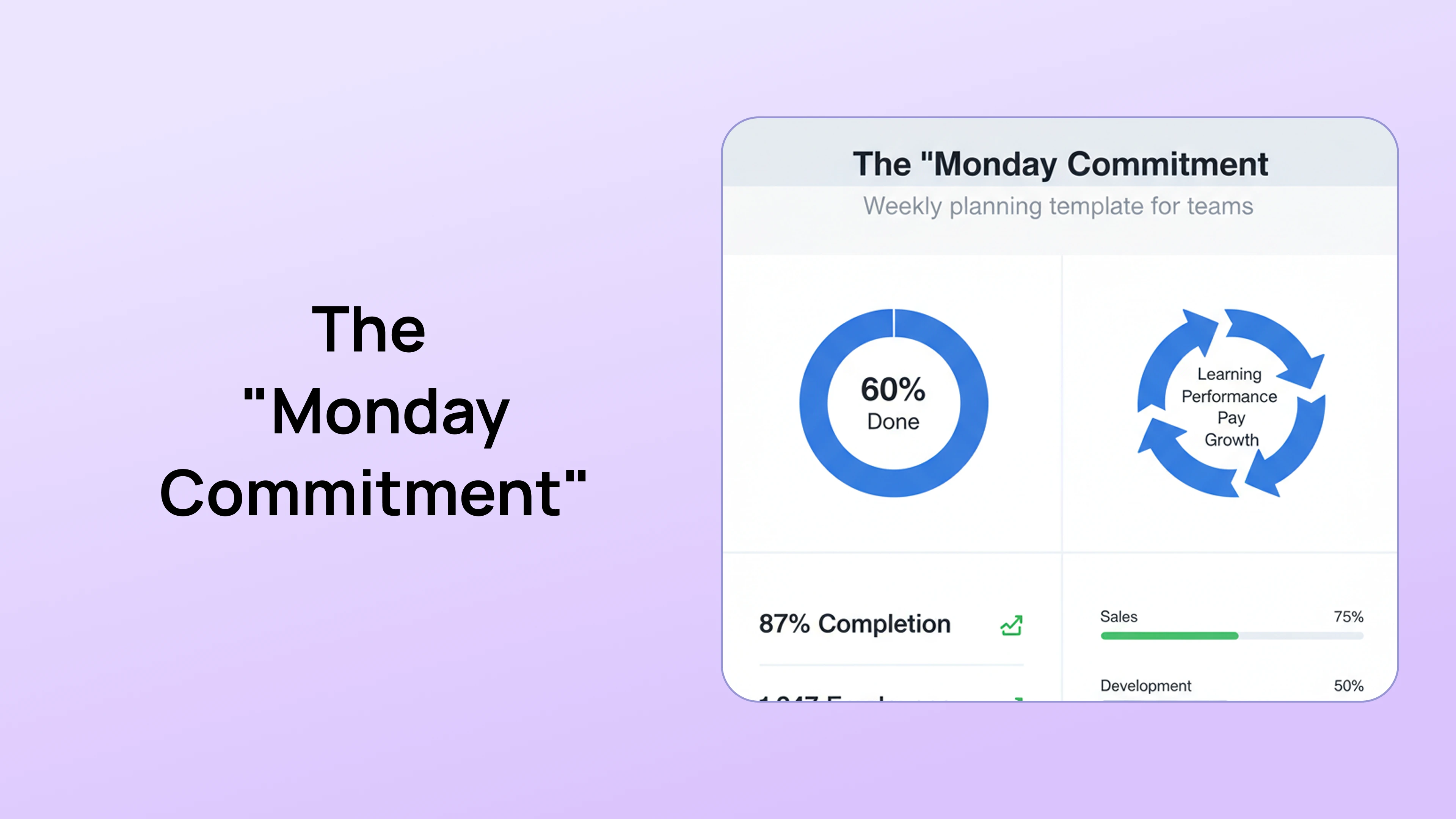
The "Monday Commitment": Replacing Micro-Management with Weekly Goal Setting
The most hated meeting in corporate history is the "Weekly Status Update."
You know the drill. 10 people sit in a room (or on a Zoom call). The manager goes around the circle, asking, "What are you working on?" The first person talks for 5 minutes while the other 9 check their email. By the time it is your turn, you have lost the will to live.
This is not management. This is adult babysitting.
When you ask people to report on their past activity, you are micro-managing. You are looking in the rearview mirror to ensure they did their homework.
In the PerformSpark Strategy (Redirect to: Month 1 Pillar Page), we believe high-performance teams do not report on the past. They commit to the future.
This guide introduces The Monday Commitment, a 15-minute ritual that replaces the hour-long status meeting. It shifts the dynamic from "compliance" to "autonomy" and ensures that every week starts with clear, undeniable focus.
The Psychology: Reporting vs. Committing
To fix your meetings, you must understand why Status Updates fail.
Reporting is Passive.
When an employee reports "I worked on the website," they are describing effort. Effort does not equal value. You can work on a website for 40 hours and ship nothing. Reporting often encourages presenteeism, where people focus on looking busy to avoid getting into trouble rather than delivering meaningful results.
Committing is Active.
When an employee says "I will ship the Home Page by Friday," they are making a promise. This triggers a psychological concept called the Consistency Principle.
Humans have a deep desire to be consistent with their public assertions. If I tell my team I will do X, I am significantly more likely to do X than if my boss tells me to do it.
The Shift:
- Old Way: "What did you do?" (Interrogation)
- New Way: "What will you finish?" (Negotiation)
The Protocol: The 3-Question Stand-up
The Monday Commitment is not a discussion. It is a rapid-fire alignment session. It should take no more than 15 minutes for a team of 8.
Every team member answers three specific questions. These questions are designed to filter out noise and focus on Key Results.
Question 1: "What is the One Thing I must ship this week?"
Not a list of 10 tasks. Just the One Thing.
If everything is a priority, nothing is. By forcing the employee to choose one major outcome, you teach them prioritization.
- Bad Answer: "I'm working on sales emails."
- Good Answer: "I am sending 50 customized proposals to the Enterprise list."
Question 2: "How does this move our Quarterly Goal?"
This prevents “zombie work,” which refers to tasks that appear productive but do not contribute to the company’s strategy.
The Alignment Check: If the employee cannot explain how their "One Thing" helps the team hit its Q1 target, they should not be doing it. This is the moment a manager steps in to correct the course.
Question 3: "Where am I blocked?"
This turns the manager from a "Task Master" into a "Blocker Remover."
- The Ask: "I am blocked waiting for Design assets."
- The Manager's Job: "I will call the Design Lead immediately after this meeting to clear that path."
The "Anti-Micro-Management" Contract
Micro-management happens when there is a trust vacuum. A manager hovers because they do not know if the work will get done.
The Monday Commitment fills that vacuum with a contract.
The Logic:
- Monday: Employee explicitly states, "I will deliver X."
- Tuesday-Thursday: Manager leaves them alone. No checking in. No "Just curious" Slacks. The contract is set.
- Friday: The results are reviewed.
This gives the employee exactly what they want: Autonomy.
It gives the manager exactly what they want: Predictability.
If the employee delivers on Friday, trust increases. If they miss, the conversation is not about "activity" (Did you work hard?); it is about "estimation" (Why did we miss the commitment?). This is a coaching conversation, not a disciplinary one.
Closing the Loop: The Friday Win
You cannot have a Monday Commitment without a Friday celebration. If you only ask for work but never acknowledge completion, the ritual becomes a chore.
We call this "The Friday Win."
The 10-Minute Show and Tell
At 4:00 PM on Friday (or via an asynchronous Slack thread), the team circles back.
- The Prompt: "Did you ship your One Thing?"
- The Rule: Binary answers only. Yes or No.
- The Reward: If Yes, the team celebrates. If No, the team asks, "How can we help you cross the line next week?"
This creates a dopamine loop. The brain starts to crave the feeling of saying "Yes" on Friday, which drives focus throughout the week. It builds a culture of shipping, not just working.
How TrAI Automates the Ritual
In a remote or hybrid world, getting everyone on a call at 9:00 AM is difficult. TrAI allows you to run this process asynchronously without losing the accountability.
The Monday Morning Nudge
- 09:00 AM: TrAI sends a Slack message to the team channel.
- The Prompt: "Good morning! What is your One Thing for this week?"
- The Integration: TrAI pulls data from your project management tool (Jira/Asana) to suggest items. "I see you have the 'Checkout Page' due on Wednesday. Is that your One Thing?"
The "Blocker" Alert
- The Scan: If an employee replies "I am blocked by Legal," TrAI automatically tags the Legal representative or the Manager.
- The Action: It creates a ticket in the Continuous Feedback Loop to ensure the blocker is not forgotten.
Handling Resistance: "We are too busy for this"
When you introduce this, your team might roll their eyes. "Another process?"
Here is how you handle the objection.
The "Time Trade" Argument
- Manager: "We are not adding a meeting. We are deleting one. We are canceling the 60-minute Status Update and replacing it with this 15-minute Commitment Stand-up. I am giving you back 45 minutes of your life every week."
The "Sales vs. Engineering" Nuance
- Sales Teams: They commit to a number. "I will close $10k this week."
- Engineering Teams: They commit to a milestone. "I will merge the API branch."
Refer to our guide on Engineering vs. Sales Goals to customize the language for each tribe.
Conclusion
Stop managing time. Start managing focus.
Micro-management is a symptom of weak goal setting. If you have to ask your team "What are you doing?" Every day, you have failed to set clear expectations on Monday.
The Monday Commitment is the operating system for high-trust teams. It forces clarity, exposes blockers early, and gives your high performers the space they need to execute.
Do not start another week drifting. Commit to the One Thing.
Book a Consultative Demo and let TrAI facilitate your first Monday Commitment session automatically.
The "Monday Commitment": Replacing Micro-Management with Weekly Goal Setting
The most hated meeting in corporate history is the "Weekly Status Update."
You know the drill. 10 people sit in a room (or on a Zoom call). The manager goes around the circle, asking, "What are you working on?" The first person talks for 5 minutes while the other 9 check their email. By the time it is your turn, you have lost the will to live.
This is not management. This is adult babysitting.
When you ask people to report on their past activity, you are micro-managing. You are looking in the rearview mirror to ensure they did their homework.
In the PerformSpark Strategy (Redirect to: Month 1 Pillar Page), we believe high-performance teams do not report on the past. They commit to the future.
This guide introduces The Monday Commitment, a 15-minute ritual that replaces the hour-long status meeting. It shifts the dynamic from "compliance" to "autonomy" and ensures that every week starts with clear, undeniable focus.
The Psychology: Reporting vs. Committing
To fix your meetings, you must understand why Status Updates fail.
Reporting is Passive.
When an employee reports "I worked on the website," they are describing effort. Effort does not equal value. You can work on a website for 40 hours and ship nothing. Reporting often encourages presenteeism, where people focus on looking busy to avoid getting into trouble rather than delivering meaningful results.
Committing is Active.
When an employee says "I will ship the Home Page by Friday," they are making a promise. This triggers a psychological concept called the Consistency Principle.
Humans have a deep desire to be consistent with their public assertions. If I tell my team I will do X, I am significantly more likely to do X than if my boss tells me to do it.
The Shift:
- Old Way: "What did you do?" (Interrogation)
- New Way: "What will you finish?" (Negotiation)
The Protocol: The 3-Question Stand-up
The Monday Commitment is not a discussion. It is a rapid-fire alignment session. It should take no more than 15 minutes for a team of 8.
Every team member answers three specific questions. These questions are designed to filter out noise and focus on Key Results.
Question 1: "What is the One Thing I must ship this week?"
Not a list of 10 tasks. Just the One Thing.
If everything is a priority, nothing is. By forcing the employee to choose one major outcome, you teach them prioritization.
- Bad Answer: "I'm working on sales emails."
- Good Answer: "I am sending 50 customized proposals to the Enterprise list."
Question 2: "How does this move our Quarterly Goal?"
This prevents “zombie work,” which refers to tasks that appear productive but do not contribute to the company’s strategy.
The Alignment Check: If the employee cannot explain how their "One Thing" helps the team hit its Q1 target, they should not be doing it. This is the moment a manager steps in to correct the course.
Question 3: "Where am I blocked?"
This turns the manager from a "Task Master" into a "Blocker Remover."
- The Ask: "I am blocked waiting for Design assets."
- The Manager's Job: "I will call the Design Lead immediately after this meeting to clear that path."
The "Anti-Micro-Management" Contract
Micro-management happens when there is a trust vacuum. A manager hovers because they do not know if the work will get done.
The Monday Commitment fills that vacuum with a contract.
The Logic:
- Monday: Employee explicitly states, "I will deliver X."
- Tuesday-Thursday: Manager leaves them alone. No checking in. No "Just curious" Slacks. The contract is set.
- Friday: The results are reviewed.
This gives the employee exactly what they want: Autonomy.
It gives the manager exactly what they want: Predictability.
If the employee delivers on Friday, trust increases. If they miss, the conversation is not about "activity" (Did you work hard?); it is about "estimation" (Why did we miss the commitment?). This is a coaching conversation, not a disciplinary one.
Closing the Loop: The Friday Win
You cannot have a Monday Commitment without a Friday celebration. If you only ask for work but never acknowledge completion, the ritual becomes a chore.
We call this "The Friday Win."
The 10-Minute Show and Tell
At 4:00 PM on Friday (or via an asynchronous Slack thread), the team circles back.
- The Prompt: "Did you ship your One Thing?"
- The Rule: Binary answers only. Yes or No.
- The Reward: If Yes, the team celebrates. If No, the team asks, "How can we help you cross the line next week?"
This creates a dopamine loop. The brain starts to crave the feeling of saying "Yes" on Friday, which drives focus throughout the week. It builds a culture of shipping, not just working.
How TrAI Automates the Ritual
In a remote or hybrid world, getting everyone on a call at 9:00 AM is difficult. TrAI allows you to run this process asynchronously without losing the accountability.
The Monday Morning Nudge
- 09:00 AM: TrAI sends a Slack message to the team channel.
- The Prompt: "Good morning! What is your One Thing for this week?"
- The Integration: TrAI pulls data from your project management tool (Jira/Asana) to suggest items. "I see you have the 'Checkout Page' due on Wednesday. Is that your One Thing?"
The "Blocker" Alert
- The Scan: If an employee replies "I am blocked by Legal," TrAI automatically tags the Legal representative or the Manager.
- The Action: It creates a ticket in the Continuous Feedback Loop to ensure the blocker is not forgotten.
Handling Resistance: "We are too busy for this"
When you introduce this, your team might roll their eyes. "Another process?"
Here is how you handle the objection.
The "Time Trade" Argument
- Manager: "We are not adding a meeting. We are deleting one. We are canceling the 60-minute Status Update and replacing it with this 15-minute Commitment Stand-up. I am giving you back 45 minutes of your life every week."
The "Sales vs. Engineering" Nuance
- Sales Teams: They commit to a number. "I will close $10k this week."
- Engineering Teams: They commit to a milestone. "I will merge the API branch."
Refer to our guide on Engineering vs. Sales Goals to customize the language for each tribe.
Conclusion
Stop managing time. Start managing focus.
Micro-management is a symptom of weak goal setting. If you have to ask your team "What are you doing?" Every day, you have failed to set clear expectations on Monday.
The Monday Commitment is the operating system for high-trust teams. It forces clarity, exposes blockers early, and gives your high performers the space they need to execute.
Do not start another week drifting. Commit to the One Thing.
Book a Consultative Demo and let TrAI facilitate your first Monday Commitment session automatically.




.svg)

.svg)
.svg)