
.svg)





Table of Contents

Quick Takeaways: Rapid Performance Review Launch
- Launch speed depends on clean data, limited scope, clear ownership, tested permissions, and available decision-makers.
- Start with a minimum viable review cycle instead of introducing every talent process at once.
- Test the complete employee, manager, approver, and HR experience before launch.
- Use the first cycle to establish a reliable workflow, then improve templates and add complexity based on evidence.
A performance review cycle can be launched quickly when the organization already has clean employee data, clear ownership, a simple review design, and leaders who can make decisions without repeated approval loops. Speed comes from reducing unnecessary scope, not from skipping testing, permissions, communication, or manager preparation.
A rapid launch should create a usable first cycle that can be improved later. It should not attempt to build every role-specific competency, automate every talent process, or introduce reviews, goals, 360 feedback, calibration, development, and recognition at the same time.
This guide provides a 10-step launch plan for a focused performance review cycle. The actual timeline depends on data quality, integrations, process complexity, security review, stakeholder availability, and the size of the rollout.
What Makes a Rapid Launch Possible?
A faster launch is realistic when:
- One executive sponsor can resolve policy decisions
- HR owns the review design and timeline
- Employee and reporting data are accurate
- The first cycle uses a limited number of templates
- The rating scale is already defined or intentionally simple
- Permissions and visibility rules are documented
- Manager training can be delivered before the cycle opens
- A pilot group is available for testing
- Integrations are available or a controlled initial import is acceptable
A fast timeline is less realistic when the organization is redesigning job architecture, creating competencies for every role, replacing the HRIS, harmonizing global policies, or seeking approval from many business units at once.
Choose a Minimum Viable Review Cycle
The first launch should include the minimum process needed to produce a useful employee conversation and reliable record.
A practical first-cycle scope may include:
- Employee self-assessment
- Manager assessment
- A small number of role-relevant questions
- Goal progress
- A clearly defined rating scale, if ratings are required
- One approval step, only where needed
- A review meeting
- Development actions and follow-up
Add peer feedback, 360-degree reviews, advanced calibration groups, or multiple role templates only when they are necessary for the launch objective.
10 Steps to Launch a Performance Review Cycle
1. Define the outcome
Write a short launch statement explaining what the cycle should produce. For example: “Complete a mid-year employee and manager review that updates goals, identifies development priorities, and provides HR with completion and rating visibility.”
This prevents the implementation from expanding into unrelated HR projects.
2. Confirm ownership and decision rights
Identify:
- Executive sponsor
- HR process owner
- System administrator
- Data owner
- Security or IT reviewer
- Manager-training owner
- Support contact during launch
Document who can approve template, rating, timing, visibility, and exception decisions.
3. Clean employee and manager data
Verify active employees, managers, departments, locations, titles, hire dates, and review eligibility. Incorrect reporting lines can assign reviews to the wrong manager and expose information inappropriately.
Review available HRIS and workplace integrations. When an integration is not ready for the pilot, use a controlled import process and define how changes will be handled before launch.
4. Select the review population
Decide whether the first cycle covers the full organization or a pilot group. A representative pilot should include different managers, role types, and employee experiences, not only the HR team.
Exclude groups only for a documented reason, such as recent hire status, leave, acquisition transition, or a different approved review process.
5. Configure a simple review template
A focused template may ask:
- What were the employee's most important outcomes?
- How did the employee perform against current goals?
- Which role behaviors or competencies were demonstrated?
- What should the employee continue?
- What is the most important development priority?
- What support should the manager provide?
- What goals or actions should be agreed for the next period?
The employee performance review guide explains the essential sections. Avoid long forms that collect information no one will use.
Teams that do not want to build this template from scratch can start from PerformSpark's free annual performance review template and adapt the fields to the pilot group's needs.
6. Define ratings and evidence rules
If the cycle includes ratings, publish clear definitions and examples. State whether overall ratings are selected by the manager, calculated from sections, or approved after calibration.
Managers should understand which evidence is relevant, how goal changes are handled, and how to document context. Use the rating scale guide before finalizing the structure.
7. Configure workflow, visibility, and reminders
Set:
- Cycle open and close dates
- Employee, manager, peer, and approver assignments
- Visibility of each response
- Required and optional fields
- Reminder timing
- Escalation rules
- Calibration dates
- Review meeting and acknowledgment steps
Smart notifications can support completion, but reminders should not overwhelm users or expose sensitive details.
8. Test the complete experience
Test as:
- An employee completing a self-review
- A manager reviewing several employees
- An approver
- An HR administrator
- A calibration participant, where applicable
Check desktop and mobile display, email links, permissions, saved drafts, required fields, reminders, reports, and what the employee sees after completion.
9. Prepare managers and employees
Manager preparation should cover:
- The purpose of the cycle
- Rating definitions
- Evidence expectations
- Writing behavior-focused feedback
- How to run the meeting
- How to handle questions or disagreement
- System steps and support
Employees need dates, expectations, visibility rules, self-assessment guidance, and a clear explanation of what happens after submission.
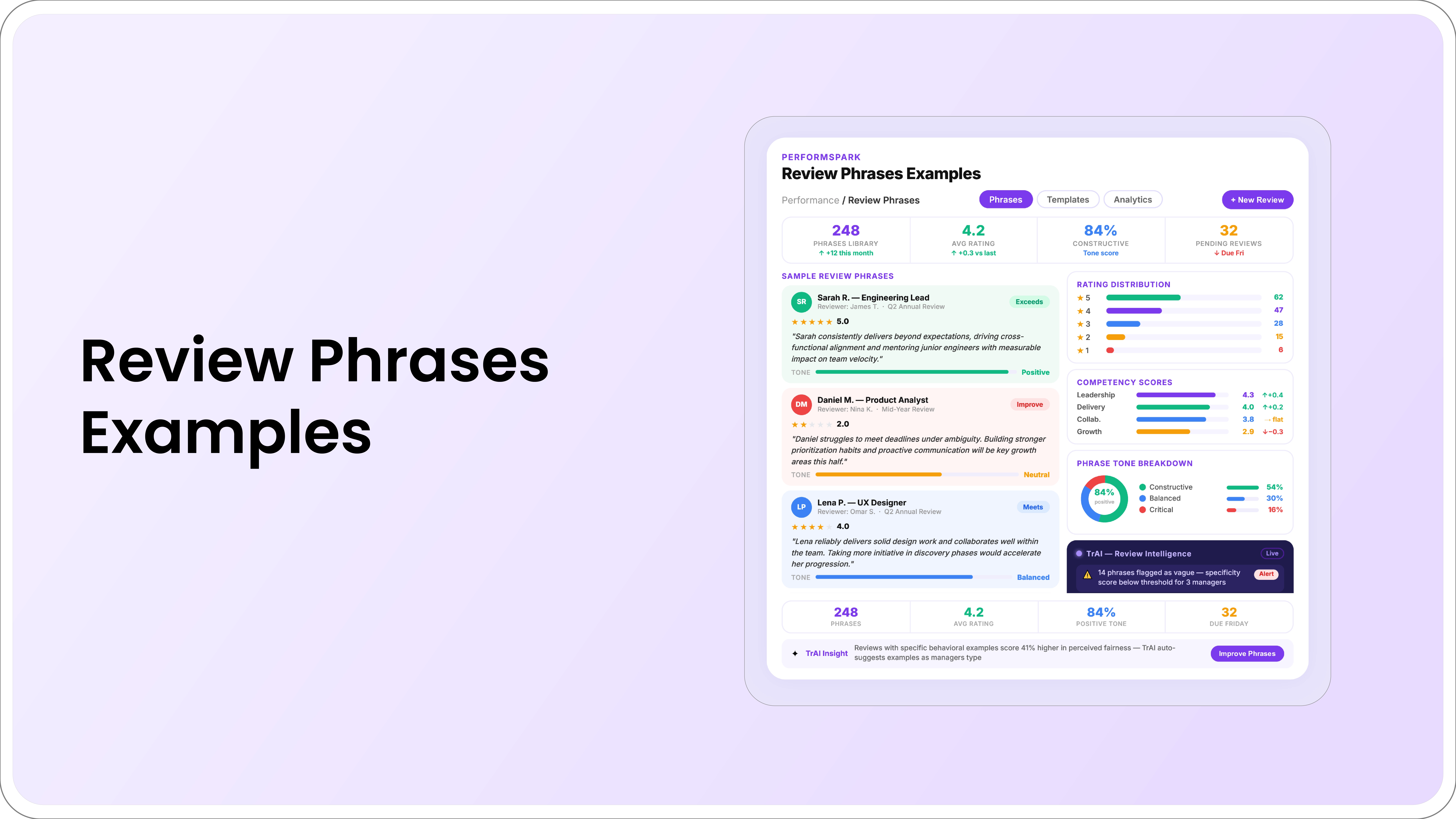
Managers can use the performance review phrase examples as starting points, but every comment should be adapted to actual evidence.
10. Launch, monitor, and improve
During the cycle, monitor:
- Completion by stage and team
- Login and access problems
- Missing or low-quality comments
- Manager questions
- Reporting-line changes
- Approval bottlenecks
- Calibration readiness
After the cycle, review user feedback, support requests, completion timing, rating patterns, and development follow-through. Improve the template and workflow before adding more complexity.
A Sample Rapid Launch Sequence
The following sequence is illustrative rather than a guaranteed timetable:
- Confirm scope, owner, population, and dates.
- Clean employee data and confirm integration or import method.
- Configure the template, rating scale, workflow, and permissions.
- Test with HR and a small manager group.
- Correct defects and finalize communication.
- Train managers and brief employees.
- Launch the cycle.
- Monitor completion and resolve exceptions.
- Prepare and run calibration, where required.
- Deliver reviews and connect next steps to goals or development plans.
When to Delay the Launch
Delay or reduce scope when:
- Employee-manager data are materially inaccurate
- Permissions have not been tested
- The organization cannot explain how ratings will be used
- Managers have not received the review standards
- The employee experience contains broken or missing steps
- A critical security or legal review is incomplete
- The launch conflicts with a major organizational event
- There is no owner for support or exceptions
A short delay to correct a critical issue is better than launching a process that assigns reviews incorrectly or creates confusion about employee outcomes.
How AI Can Support a Rapid Launch
AI may help summarize connected evidence, suggest draft review language, identify missing information, or prepare rating distributions. It should not be used to compensate for inaccurate data, unclear expectations, or missing manager judgment.
The AI performance review software guide explains how to evaluate evidence, transparency, permissions, and human oversight.
Rapid Launch Mistakes to Avoid
- Trying to launch every module at once
- Building a separate template for every job title
- Skipping permission testing
- Assuming an intuitive interface eliminates process training
- Using automated reminders without clear ownership
- Launching ratings without definitions
- Ignoring mobile and email-link testing
- Adding AI before the underlying records are reliable
- Failing to define what happens after the review
Launch a Focused Review Cycle With PerformSpark
PerformSpark connects review templates, assignments, reminders, goals, check-ins, calibration, development, and completion reporting in one workflow.
Explore PerformSpark pricing or book a personalized demo to plan a launch based on your data, review design, integrations, and manager population.




.svg)

.svg)
.svg)