

.svg)





.webp)
Table of Contents

Quick Takeaways: IDP Examples and Templates
- Every IDP should define a focused priority, observable success evidence, practical activities, milestones, and manager support.
- Adapt role examples to the employee's actual responsibilities and available opportunities instead of copying them unchanged.
- Combine learning with practice, feedback, and real work.
- Review progress during normal check-ins and revise goals when priorities or opportunities change.
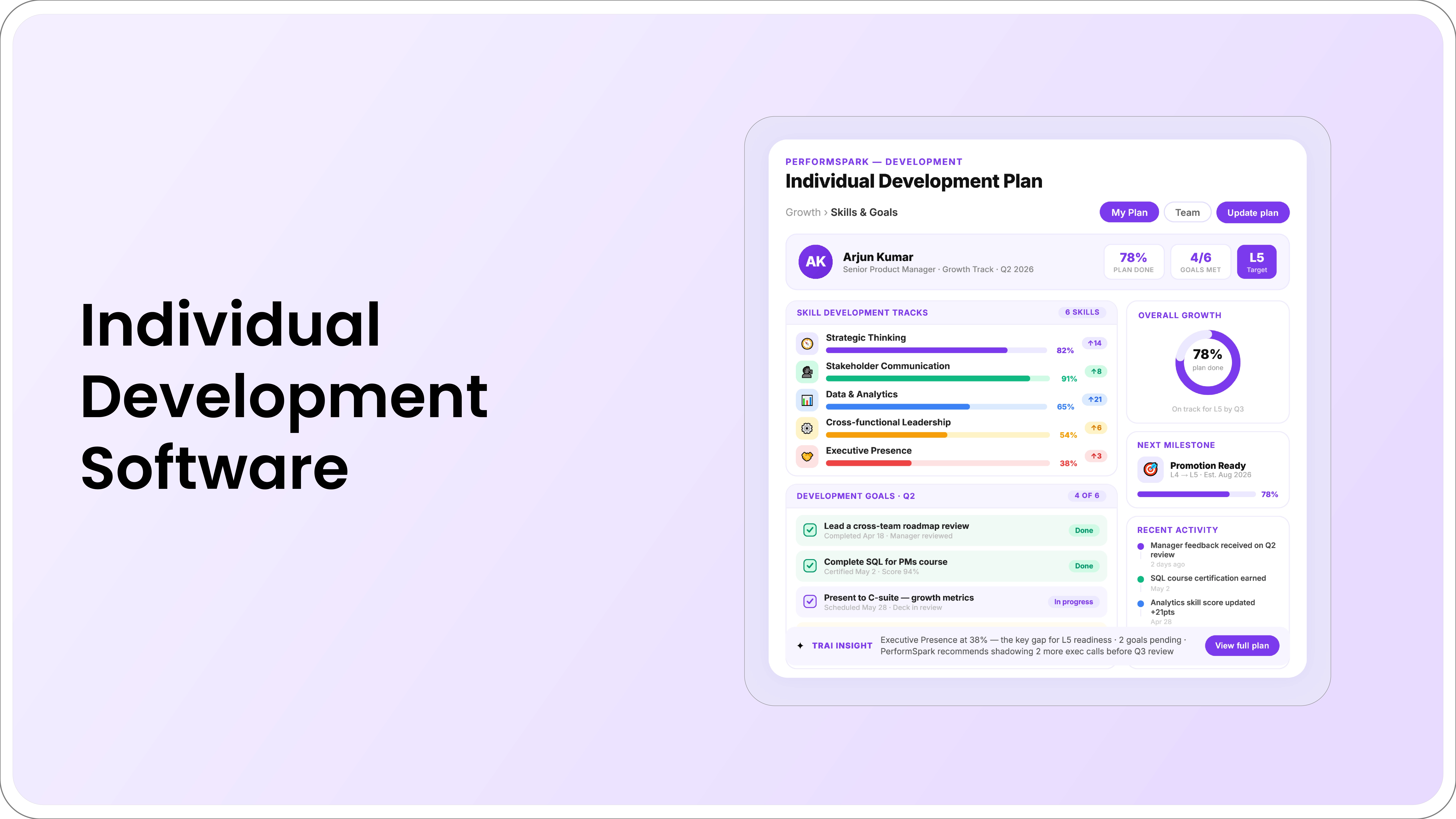
An individual development plan turns a capability or career goal into practical actions, milestones, support, and review dates. The strongest plans are specific enough to guide the employee and flexible enough to adapt when work or priorities change.
This guide includes a reusable IDP template and ten examples for individual contributors, managers, and HR teams. Replace every sample activity, date, and measure with information that fits the employee's role and available opportunities.
For program design and manager guidance, review the individual development plan best practices. For connected workflow capabilities, review the IDP software buyer guide.
What Is an Individual Development Plan?
An individual development plan, or IDP, is a collaborative plan that describes:
- The capability or experience the employee wants to build
- Why the goal matters
- What successful development will look like
- The activities the employee will complete
- The manager or organizational support required
- Milestones and review dates
IDPs can follow a performance review, career conversation, role change, project retrospective, or 360-degree review. They are appropriate for employees at different performance levels and career stages.
Fill-In Individual Development Plan Template
1. Development priority
Capability or experience: [Describe the skill, behavior, knowledge, or responsibility.]
Reason: [Explain how it connects to the employee's current role, future direction, feedback, or team need.]
2. Success evidence
[Describe the observable behavior, work sample, completed assignment, stakeholder feedback, or result that would demonstrate progress.]
3. Development activities
- Practice or stretch assignment: [Insert]
- Coaching or mentoring: [Insert]
- Observation or shadowing: [Insert]
- Course, reading, or formal learning: [Insert]
4. Milestones
- Milestone 1 and date: [Insert]
- Milestone 2 and date: [Insert]
- Final review date: [Insert]
5. Employee responsibilities
[List preparation, participation, practice, documentation, and follow-up owned by the employee.]
6. Manager and organizational support
[List assignments, introductions, feedback, time, budget, access, and barriers the manager or organization will address.]
7. Review cadence
[State when progress will be reviewed during normal 1-on-1 check-ins or milestone meetings.]
How to Adapt the Examples
Each example below uses the same structure:
- Development priority
- Success evidence
- Activities
- Milestones
- Manager support
Do not copy a sample goal merely because the job title matches. Confirm the employee's actual responsibility, feedback, career direction, available work, and manager capacity.
1. Software Engineer: Technical Design Leadership
Development priority: Build the ability to lead technical design for a medium-complexity feature.
Success evidence: Produce a design proposal that explains requirements, options, dependencies, risks, testing, and implementation stages, then lead the review and incorporate agreed feedback.
Activities:
- Observe two technical design reviews
- Review prior approved design documents
- Draft one design with support from a technical lead
- Lead one independent design review
Milestones: Observation complete by [date]; supported draft by [date]; independent review by [date].
Manager support: Select an appropriate feature, introduce the technical reviewer, protect preparation time, and provide feedback after each stage.
2. Marketing Coordinator: Campaign Analysis
Development priority: Interpret campaign data and turn it into clear recommendations.
Success evidence: Prepare a monthly campaign summary that identifies performance against the agreed objective, explains important changes, and recommends one next action using verified data.
Activities:
- Review the current reporting definitions and data sources
- Shadow an analyst during two campaign reviews
- Prepare one report with analyst feedback
- Present one report independently
Milestones: Data-source review by [date]; supported report by [date]; independent presentation by [date].
Manager support: Confirm the approved measures, arrange analyst support, and provide a real campaign for practice.
3. Sales Representative: Discovery and Qualification
Development priority: Improve discovery conversations and opportunity qualification.
Success evidence: Use the agreed discovery framework consistently, document customer priorities and decision criteria, and explain why each active opportunity meets the team's qualification standard.
Activities:
- Listen to two strong discovery calls
- Practice the question framework with the manager
- Review notes from the next [number] discovery calls
- Conduct a pipeline review focused on qualification evidence
Milestones: Observation and practice by [date]; first call-note review by [date]; final pipeline review by [date].
Manager support: Provide call examples, observe selected calls, and give feedback on questioning, listening, and next-step clarity.
4. Customer Success Manager: Risk Management
Development priority: Identify and escalate customer risk earlier.
Success evidence: Maintain a documented risk view for assigned customers, explain the evidence behind each risk level, and create an owner and next action for material issues.
Activities:
- Review the team's customer-risk definitions
- Compare two completed risk-response plans
- Prepare one supported plan for an active account
- Lead one cross-functional risk review
Manager support: Select representative accounts, involve relevant product or support partners, and review the first plan.
5. Operations Specialist: Process Improvement
Development priority: Diagnose a recurring workflow problem and implement a controlled improvement.
Success evidence: Map the current process, identify the root cause, propose a change with risks and owners, test it with a limited group, and document the result.
Activities:
- Learn the approved process-mapping method
- Interview employees who complete the work
- Develop a current-state and proposed-state map
- Run a pilot and review the outcome
Manager support: Approve the pilot scope, provide access to process owners, and help resolve cross-team dependencies.
6. Finance Analyst: Executive Communication
Development priority: Present financial analysis as a concise business recommendation.
Success evidence: Deliver a presentation that explains the question, material assumptions, key findings, risks, options, and recommended action without unnecessary detail.
Activities:
- Review examples of effective executive summaries
- Rewrite one existing report into a decision-focused format
- Present to the manager for feedback
- Lead one live stakeholder discussion
Manager support: Select an appropriate business question, review the first narrative, and provide stakeholder context.
7. HR Business Partner: People Analytics
Development priority: Use workforce information to identify a practical question and recommend action.
Success evidence: Prepare a quarterly people review that distinguishes facts from interpretation, explains data limitations, and identifies one question requiring leader action.
Activities:
- Review HR data definitions and access requirements
- Partner with an analyst on one report
- Prepare a supported analysis
- Present findings to the relevant business leader
Manager support: Arrange data access, identify an analyst partner, and confirm the business question before analysis begins.
8. First-Time Manager: Structured Coaching
Development priority: Run consistent coaching conversations that result in clear actions and support.
Success evidence: Use a repeatable agenda, ask open questions, document agreed actions, and complete promised follow-up across the review period.
Activities:
- Review the team's check-in expectations
- Observe an experienced manager
- Use a structured agenda with each direct report
- Review selected notes and actions with the manager's leader
Manager support: Provide observation opportunities, debrief difficult conversations, and review whether the new manager is receiving enough time to coach.
9. Senior Manager: Cross-Functional Influence
Development priority: Resolve cross-team decisions through evidence, shared interests, and clear ownership rather than unnecessary escalation.
Success evidence: Lead two cross-functional decisions in which options, tradeoffs, owners, and next actions are documented and accepted by the relevant partners.
Activities:
- Identify recurring decision bottlenecks
- Map stakeholders and decision rights
- Prepare a decision document for one issue
- Request feedback from participating peers
Manager support: Clarify decision authority, sponsor an appropriate issue, and provide feedback without taking over the discussion.
10. Frontline Supervisor: Delegation and Follow-Through
Development priority: Delegate routine work with clear outcomes, authority, checkpoints, and support.
Success evidence: Assign work using the agreed delegation structure, allow the employee appropriate decision space, and review progress without reclaiming the task unnecessarily.
Activities:
- Select two repeatable responsibilities suitable for delegation
- Define expected outcomes and decision authority
- Hold scheduled progress reviews
- Gather feedback from the employees receiving the work
Manager support: Help select suitable responsibilities, observe one delegation conversation, and coach the supervisor on balancing oversight and ownership.
IDP Example for a Career Direction That Is Not Yet Confirmed
An employee may want to explore a future role without committing to a promotion path that is not available or appropriate.
Development priority: Explore whether project leadership fits the employee's interests and strengths.
Success evidence: Complete one limited project-lead assignment, gather feedback, and document which parts of the responsibility were energizing, difficult, or require more development.
Activities: Shadow a project lead, own one planning meeting, maintain the action log, and complete a reflection with the manager.
This type of exploratory goal allows learning without promising a role change.
Common IDP Template Mistakes
- Using a broad capability without defining observable success
- Listing a course as the entire plan
- Creating too many goals
- Leaving manager support blank
- Using a final deadline without milestones
- Choosing measures outside the employee's influence
- Promising promotion as the outcome
- Failing to revise the plan when opportunities change
- Discussing the IDP only during the next annual review
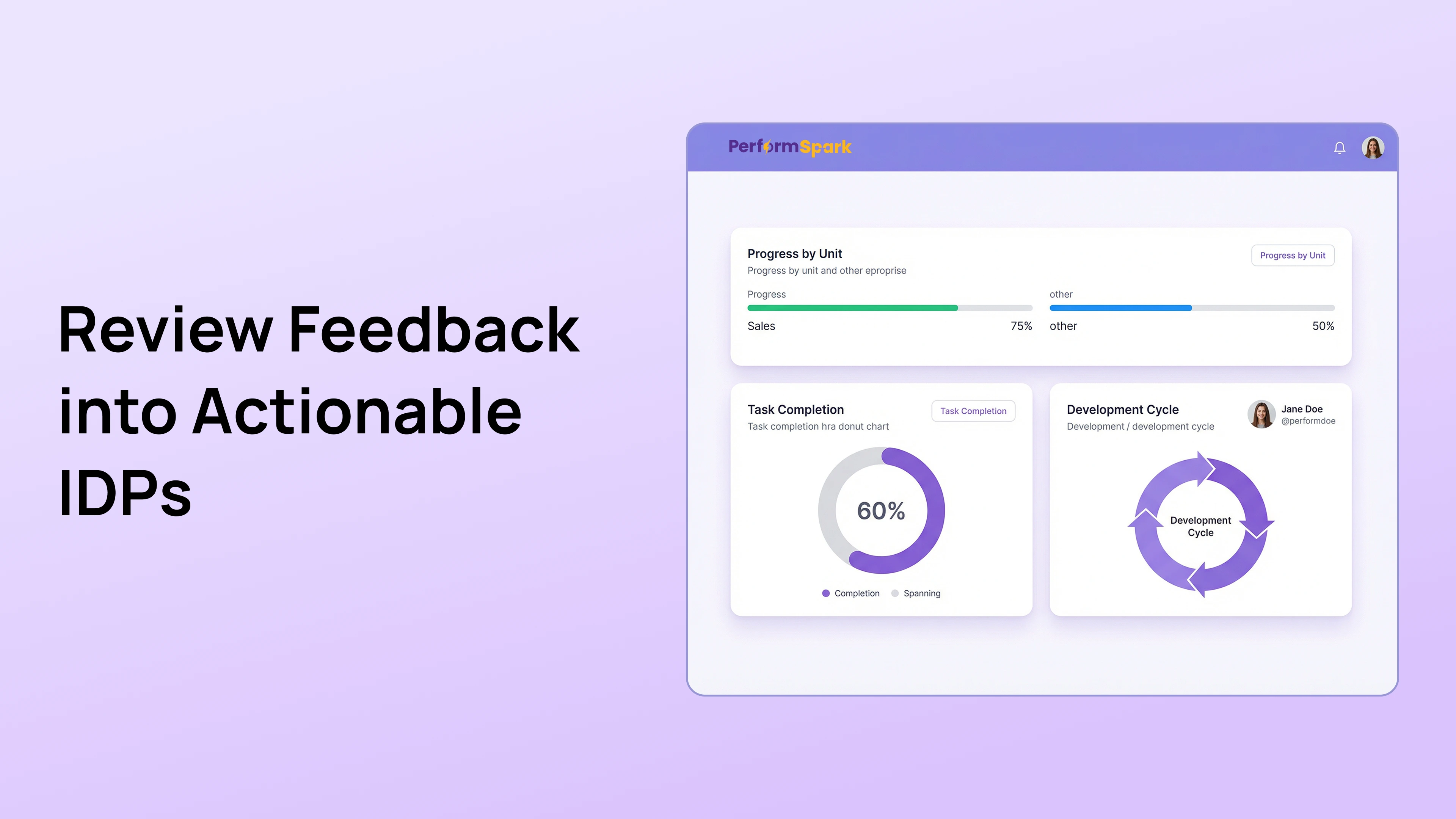
How to Track IDP Progress
At each progress review, record:
- Activities completed
- Practice or work samples
- Feedback received
- Evidence of changed behavior or capability
- Blocked or changed opportunities
- Employee and manager actions before the next review
A connected IDP workflow can keep development goals beside current performance goals, manager check-ins, and review outcomes. Smart notifications can support milestone follow-up, while the employee and manager remain responsible for evaluating progress.
Create IDPs That Lead to Real Practice
PerformSpark connects development plans with reviews, goals, check-ins, feedback, milestones, manager support, and development reporting.
Explore PerformSpark pricing or book a personalized demo to see how role-based IDPs can remain visible and actionable throughout the year.




.svg)

.svg)
.svg)