

.svg)





Table of Contents

Quick Takeaways: Individual Development Plan Best Practices
- Create the plan collaboratively and focus on one or two capabilities that matter to the employee and role.
- Define success through observable behavior or work, then combine practice, experience, coaching, and formal learning.
- Write manager support and milestone dates into the same plan as employee actions.
- Review access to stretch assignments, mentoring, sponsorship, and learning opportunities across employee groups.
An individual development plan should turn a meaningful growth priority into specific experience, learning, support, and follow-through. It should help the employee build capability while giving the manager and organization a clear role in making development possible.
IDPs often fail when they are created as annual paperwork, filled with broad goals, or disconnected from the employee's actual work. A useful plan remains visible in manager-employee check-ins, changes when priorities change, and records what both the employee and manager agreed to do.
This guide covers individual development plan best practices for HR process design and manager execution. For fill-in examples by role, use the IDP examples and templates. For software evaluation, use the individual development plan software guide.
What Is an Individual Development Plan?
An individual development plan, or IDP, is a structured agreement between an employee and manager that defines:
- The capability, experience, or career direction being developed
- Why the development matters
- The activities the employee will complete
- The support the manager or organization will provide
- Milestones and evidence of progress
- Dates for reviewing and adjusting the plan
An IDP can support employees at any performance level. It may help someone deepen current-role capability, prepare for broader responsibility, adapt to a changing role, or explore a realistic career path.
IDP vs. Performance Improvement Plan
An IDP is a normal development tool. A performance improvement plan is a more formal process used when essential role expectations are not being met and structured intervention is appropriate.
Both may contain goals, actions, support, measures, and review dates, but they have different purposes and governance:
| Area | Individual development plan | Performance improvement plan |
|---|---|---|
| Primary purpose | Build capability and support growth | Address a documented performance gap |
| Who can use it | Employees at any performance level | Employees in a formal improvement process |
| Typical ownership | Collaborative employee-manager plan | Manager-led process with HR oversight |
| Outcome | Learning, experience, capability, or readiness | Assessment against essential performance expectations |
| Employee message | Growth and career development | Formal clarification and improvement requirements |
Do not label routine development as a PIP or use an IDP to avoid addressing a serious current performance issue. HR should help managers choose the process that matches the situation.
12 Individual Development Plan Best Practices
1. Create the plan collaboratively
The manager should not assign an IDP without understanding the employee's interests, current role, prior feedback, and realistic opportunities. The employee should not create a plan without discussing organizational needs, available support, or the work required to practice the capability.
Use questions such as:
- Which part of the current role would the employee like to strengthen?
- What feedback or evidence suggests this is a useful priority?
- Which future responsibility is realistic and relevant?
- What experience would demonstrate progress?
- What support can the manager genuinely provide?
2. Start with one or two meaningful priorities
A long list of development goals competes with the employee's normal responsibilities. Select the capabilities that would make the greatest difference to current performance, future readiness, or career direction.
A development priority should be specific enough to guide action. Replace “become a better leader” with “delegate work with clearer decision authority, milestones, and definitions of success.”
3. Connect the plan to relevant evidence
IDP priorities may come from:
- The employee's self-assessment
- Manager observations
- Goal outcomes
- Project retrospectives
- Customer or stakeholder feedback
- 360-degree feedback
- A new role or responsibility
- A career conversation
Evidence should inform the priority without turning the IDP into a negative review. Explain the capability to build and the opportunity it creates.
4. Define success as observable behavior or output
Each goal should describe what will be different when development has occurred.
Too broad: “Improve strategic thinking.”
More useful: “Prepare and present two recommendations that compare options, assumptions, risks, business impact, and a proposed decision.”
Too broad: “Build presentation skills.”
More useful: “Lead the next quarterly business review using a concise narrative, evidence, a clear recommendation, and responses to stakeholder questions.”
Development does not always produce a simple score. A work sample, manager observation, stakeholder feedback, completed assignment, or demonstrated behavior may be the right evidence.
5. Use a mix of development activities
Formal training can be helpful, but development also comes from practice, feedback, coaching, observation, and responsibility. A balanced plan may include:
- A stretch assignment
- Project or meeting leadership
- Job shadowing
- Mentoring
- Manager coaching
- Peer observation
- A course, certification, or workshop
- Reading followed by application
- A presentation, work sample, or practice exercise
Choose activities that fit the capability. A course about delegation will have limited value without an opportunity to delegate real work and receive feedback.
6. Make manager support explicit
The plan should describe what the manager will do, not merely state that the manager is supportive.
Examples include:
- Provide a stretch assignment by an agreed date
- Introduce the employee to a mentor or subject-matter expert
- Review a work sample before the first high-impact use
- Protect time for learning or practice
- Observe a meeting and provide feedback
- Clarify priorities when development activities compete with delivery work
- Help remove a documented dependency
Manager commitments should appear in the same plan as employee actions so both parties can review follow-through.
7. Set milestones instead of one distant deadline
A final completion date does not show whether progress is occurring. Break the goal into stages such as preparation, supported practice, independent practice, and review.
For example:
- Observe two experienced facilitators
- Prepare an agenda and facilitation plan
- Co-facilitate one meeting
- Lead one meeting independently
- Review participant and manager feedback
Milestones help the manager provide support before the end of the plan.
8. Review progress during normal check-ins
IDP progress should not require a separate annual event. Add a short development item to regular check-ins and schedule deeper reviews when milestones are reached or priorities change.
A brief progress discussion can cover:
- What the employee practiced
- What evidence or feedback was received
- What obstacle is slowing progress
- What the employee will do next
- What support the manager owes
The right cadence depends on the activity and work. A monthly course may need different follow-up from a quarterly stretch assignment.
9. Keep the plan adaptable
Development plans should change when roles, business priorities, opportunities, or employee interests change. Record why a milestone, activity, or target was revised instead of leaving the original plan visibly overdue.
Changes should preserve the purpose of the goal or document a new agreed priority. The employee and manager should understand what is still active.
10. Make access to development equitable
HR should review whether stretch assignments, mentoring, sponsorship, training budgets, and high-visibility projects are reaching comparable employees consistently.
Useful questions include:
- Who receives development plans?
- Who receives manager time and sponsorship?
- Which employees are offered stretch assignments?
- Are remote, frontline, part-time, or distributed employees included?
- Do employees know how development opportunities are selected?
Equal development does not require identical activities. It requires clear access, relevant opportunities, and decisions that can be explained.
11. Separate completion from capability growth
Finishing a course or attending a workshop is an activity, not proof that the employee can apply the skill. Review how the employee used the learning in actual work.
Measure both:
- Activity: The course, mentoring meeting, assignment, or practice completed
- Application: The behavior, work sample, decision, or outcome demonstrating use
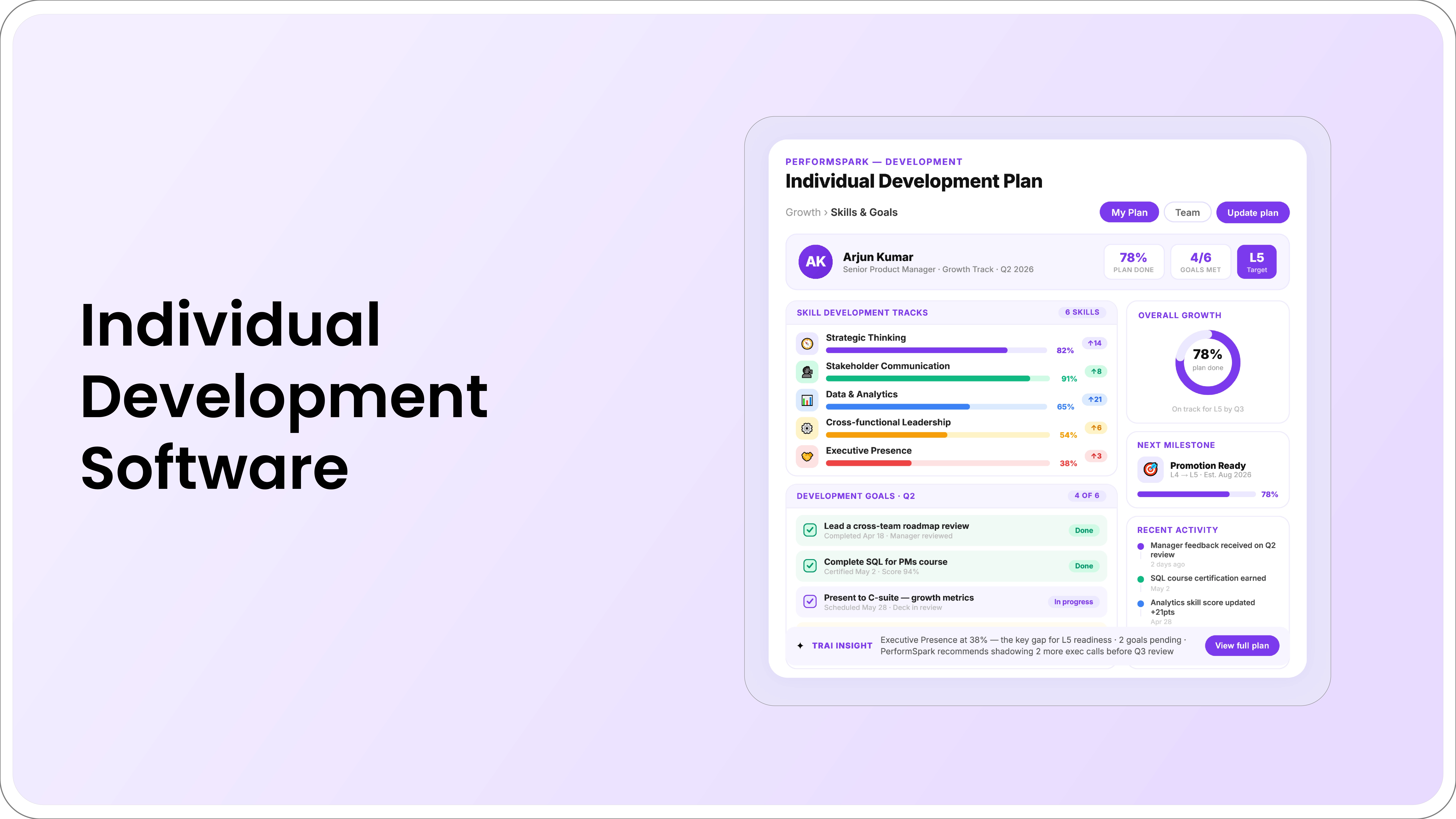
A connected development reporting view can show milestone status, but managers still need to evaluate application in context.
12. Close the plan with a documented review
When a goal is completed, the employee and manager should review:
- What was completed
- What capability changed
- Which evidence demonstrates progress
- What remains to be developed
- How the capability will be used going forward
- Whether a new development priority is appropriate
Closing the goal prevents old plans from remaining active indefinitely and creates useful context for the next performance review.
A Practical IDP Goal Structure
Use the following fields for each development priority:
- Development priority: The capability or experience
- Reason: Why it matters to the employee and role
- Success evidence: Observable behavior, output, or feedback
- Activities: Practice, experience, coaching, and learning
- Milestones: Intermediate dates and evidence
- Employee actions: What the employee owns
- Manager support: What the manager or organization owns
- Review cadence: When progress will be discussed
- Target review date: When the goal will be assessed
The goal management workflow can support dates and ownership, while the IDP retains the development context and support commitments.
How HR Should Govern the IDP Process
HR should define enough structure for consistency without turning development into a rigid compliance exercise. Governance may include:
- Who is eligible or expected to create an IDP
- When plans are created and reviewed
- Required fields
- Visibility and permissions
- Manager responsibilities
- Available learning and development resources
- How changes and completed goals are recorded
- How aggregate participation is reviewed
HR should not require every employee to have the same number of goals or use the same development activity. The plan should fit the role and employee.
HR leaders can use aggregate information to identify missing manager follow-through, access gaps, and common capability needs without using a dashboard as the final judgment on an individual employee.
Individual Development Plan Metrics
Useful process measures may include:
- Plan creation by eligible population
- Goals with defined milestones and manager support
- Upcoming and overdue development reviews
- Milestone completion
- Frequency of development discussions
- Completed stretch assignments or learning activities
- Employee and manager feedback on usefulness
- Access to development opportunities across groups
Interpret these measures carefully. A high creation rate does not prove that plans are useful. A lower completion rate may reflect poorly designed goals, changing priorities, missing opportunities, or insufficient manager support.
Common IDP Mistakes
- Assigning the plan without employee input
- Using vague goals such as “improve leadership”
- Listing only courses and certifications
- Omitting manager commitments
- Setting one distant deadline without milestones
- Discussing development only during annual reviews
- Giving development opportunities only to highly visible employees
- Treating course completion as proof of capability
- Keeping obsolete goals active after priorities change
- Using an IDP to avoid a required performance conversation
IDP Best-Practices Checklist
- The employee and manager selected the priority together.
- The goal connects to relevant evidence or a realistic career direction.
- Success is observable.
- The activities include practice and application.
- Employee and manager responsibilities are written separately.
- Milestones are scheduled.
- Progress will be reviewed in normal manager conversations.
- The plan can be revised through an agreed process.
- Development access is reviewed across employees and teams.
- The completed goal will receive a documented closeout review.
Keep Development Connected to Work
PerformSpark connects individual development plans with reviews, goals, check-ins, feedback, recognition, and reporting. Employees and managers can track the plan within the same performance workflow used throughout the year.
Explore PerformSpark pricing or book a personalized demo to see how development priorities, activities, milestones, and manager support can remain connected.
.webp)




.svg)

.svg)
.svg)