
.svg)





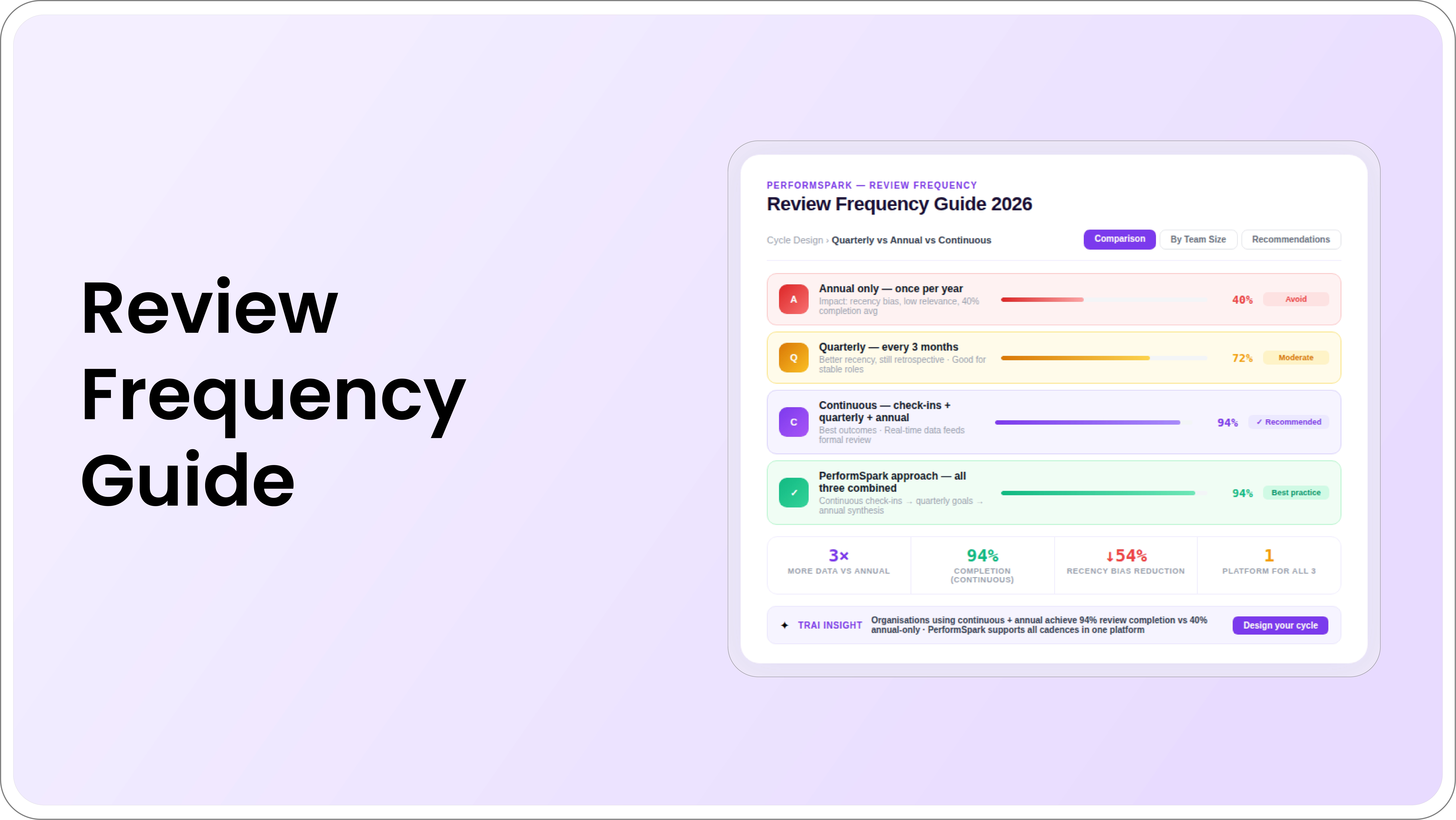
Table of Contents

Key Takeaways: Performance Review Frequency
- Most organizations benefit from a hybrid cadence: regular check-ins, quarterly goal conversations, a mid-year development review, and an annual formal assessment.
- Quarterly reviews should be focused performance snapshots, not four complete annual-review cycles.
- Review frequency should reflect company size, business pace, manager capacity, role type, and the purpose of each conversation.
How often should your organization run performance reviews? For most teams, the strongest answer is not annual, quarterly, or continuous reviews by themselves. It is a structured combination of formal reviews and regular performance conversations.
An effective cadence gives employees timely feedback, gives managers enough evidence to evaluate performance fairly, and gives HR a reliable process for compensation, development, and workforce decisions. The right schedule depends on company size, role complexity, business pace, and the purpose of each conversation.
For many mid-market organizations, the most practical model is an annual formal review supported by a mid-year development review, quarterly goal conversations, and regular 1-on-1 check-ins. This creates enough structure for consistent decisions without turning every manager conversation into a full administrative review cycle.
Why Performance Review Frequency Matters
Review frequency affects more than the HR calendar. It influences feedback quality, employee trust, manager accountability, goal alignment, and the accuracy of performance decisions.
When reviews happen too infrequently, managers must reconstruct months of performance from memory. Recent events receive more attention than work completed earlier in the cycle, and employees may learn about concerns long after they could have corrected them. A well-designed performance review process reduces this risk by collecting evidence throughout the year.
Reviews can also become too frequent. Four full-scale formal reviews every year may create unnecessary administrative work, especially when managers are completing long forms rather than having useful conversations. The goal is not to maximize the number of reviews. The goal is to match each type of conversation to a clear purpose.
The Four Main Performance Review Cadences
Annual performance reviews
Annual reviews take place once each year, usually before compensation planning or at the end of the fiscal year. They provide a complete assessment of performance, competencies, goal achievement, and readiness for expanded responsibility.
Best suited for: Organizations with stable roles, mature processes, and regular informal manager feedback throughout the year.
Main advantages: A predictable cycle, easier administration, and clear alignment with annual compensation decisions.
Main risks: Recency bias, delayed feedback, and high-pressure conversations when the annual meeting is the employee's only meaningful performance discussion.
Annual reviews work best when they summarize information already captured through goal tracking, manager notes, recognition, and ongoing feedback. They should not be the first time an employee hears how they are performing.
Organizations running this format for the first time can use PerformSpark's free annual performance review template as a starting structure rather than building the form from scratch.
Semi-annual performance reviews
A semi-annual model includes a mid-year review and a year-end review. The mid-year conversation is usually focused on progress, development, changing priorities, and support needs. The year-end review provides the complete assessment used for compensation and talent decisions.
Best suited for: Mid-sized organizations that want more structure than an annual-only process without the workload of quarterly formal reviews.
Main advantages: Earlier course correction, better development planning, and a natural point to update goals.
Main risks: Six months can still be too long between meaningful conversations when managers do not run regular check-ins.
Mid-year reviews are particularly useful for updating an employee's individual development plan and confirming whether role expectations or business priorities have changed.
Quarterly performance reviews
Quarterly reviews happen every three months. They are most effective as focused performance snapshots rather than four versions of a full annual review. A quarterly conversation might cover goal progress, priorities, manager feedback, employee support needs, and any changes required for the next quarter.
Best suited for: Fast-growing companies, project-based teams, sales organizations, technology companies, and teams using quarterly objectives.
Main advantages: Faster response to changing goals, earlier identification of performance concerns, and closer alignment between individual work and company priorities.
Main risks: Review fatigue and excessive manager workload when every quarterly review includes long forms, ratings, and approval workflows.
Quarterly reviews become easier to manage when progress is already visible in a centralized performance reporting dashboard rather than collected manually before every meeting.
Continuous performance management
Continuous performance management is an ongoing process of goal tracking, feedback, coaching, recognition, and documented manager conversations. It does not mean eliminating formal reviews or giving employees formal ratings every week.
Instead, employees receive feedback close to the work it relates to, managers record useful context throughout the year, and formal reviews summarize an established performance record.
Best suited for: Remote teams, hybrid organizations, high-growth companies, and businesses that want stronger coaching and development habits.
Main advantages: Better performance evidence, fewer surprises, faster support, and more consistent manager accountability.
Main risks: Inconsistent adoption when managers are not trained or when the system creates too much documentation work.
Automated performance reminders can help managers maintain a reliable cadence without HR repeatedly chasing incomplete check-ins and review tasks.
Recommended Performance Review Frequency for Most Organizations
For many organizations, a hybrid cadence provides the best balance between rigor and usability:
- Every two weeks or monthly: A structured manager-employee check-in covering progress, blockers, feedback, priorities, and support.
- Quarterly: A focused goal and performance conversation aligned with business priorities.
- Mid-year: A formal development review that evaluates progress and updates career-development priorities.
- Annually: A complete performance review used for calibrated ratings, compensation input, succession discussions, and workforce planning.
This model separates coaching from compensation. Employees receive useful feedback throughout the year, while the annual review remains a structured decision point.
For organizations concerned about inconsistent ratings between managers, a formal performance calibration process should follow the annual review cycle. Calibration helps HR compare rating patterns, surface manager bias, and apply common standards across teams.
How Company Size Should Influence Review Cadence
Organizations with fewer than 50 employees
Smaller organizations can often support quarterly conversations because managers have fewer direct reports and senior leaders have greater visibility into performance. However, a lightweight format is essential. Small teams rarely need a complex rating and approval process every quarter.
A practical model is quarterly goal and feedback conversations, supported by an annual formal assessment. Growing teams can use structured employee feedback surveys to identify manager or engagement issues that may not appear in individual reviews.
Organizations with 50 to 500 employees
Mid-market organizations usually benefit most from the hybrid model. Annual and mid-year reviews provide consistency across departments, while regular check-ins and quarterly goal updates maintain momentum.
The process must also be flexible enough to support different functions. A sales team may need quarterly performance snapshots, while a corporate operations team may need only mid-year and annual formal reviews. Performance management for mid-market companies should allow HR to standardize governance without forcing every team into the same workflow.
Organizations with more than 500 employees
Larger organizations need to consider manager capacity, review completion rates, approval layers, and calibration requirements. Four formal reviews per employee can become difficult to sustain across a large workforce.
Annual formal reviews supported by structured check-ins are often more practical. Role-based workflows, 360-degree feedback, and automated reporting can be added for leadership, high-potential, or development-focused populations without increasing complexity for every employee.
How Business Pace and Role Type Affect Frequency
Review cadence should reflect how quickly work and expectations change.
Fast-moving teams may need quarterly performance conversations because priorities, products, and responsibilities can shift within a few months. Stable operational roles may not require frequent formal assessments, but employees still benefit from regular coaching and recognition.
New employees also need a different cadence. A 30-, 60-, and 90-day check-in process helps managers clarify expectations and identify support needs before the first annual review. Managers should document early performance concerns and, when required, use a structured performance improvement plan rather than waiting for the next formal review cycle.
What to Cover at Each Review Frequency
Regular check-ins
- Current priorities and blockers
- Recent feedback and recognition
- Support required from the manager
- Development actions
- Changes to goals or responsibilities
Quarterly conversations
- Progress against goals
- Key achievements and challenges
- Performance patterns from the previous quarter
- Priorities for the next quarter
- Coaching or development needs
Mid-year reviews
- Progress against annual expectations
- Strengths and development priorities
- Career interests and internal opportunities
- Updates to the employee's development plan
- Any support required before year-end
Annual reviews
- Complete performance assessment
- Goal achievement
- Competency or behavior ratings
- Evidence gathered throughout the year
- Overall rating and calibration input
- Compensation and promotion recommendations, where applicable
A consistent review framework is easier to maintain when managers can access templates, goals, prior feedback, and development records inside one performance management platform.
Common Performance Review Frequency Mistakes
Using the annual review as the only feedback conversation
Employees should not wait twelve months to receive meaningful feedback. Regular check-ins reduce surprises and give employees time to improve before formal decisions are made.
Running four annual reviews every year
Quarterly conversations should be shorter and more focused than year-end reviews. Repeating the full annual process every quarter creates unnecessary work and often reduces completion quality.
Using the same cadence for every employee population
New hires, leaders, project-based teams, and employees in development programs may need different frequencies. The overall framework should be consistent, but HR should allow appropriate variations.
Failing to document ongoing feedback
Frequent conversations provide little value at annual review time when there is no record of what was discussed. Managers need a simple method to capture decisions, achievements, commitments, and follow-up actions.
Connecting every conversation to compensation
Development conversations become less open when employees believe every comment immediately affects pay. Separating coaching from compensation encourages more useful discussion and creates a healthier feedback culture.
How to Select the Right Review Cadence
Before changing review frequency, HR teams should answer five questions:
- What decision or outcome should each conversation support?
- How quickly do employee goals and responsibilities change?
- How many direct reports does the average manager support?
- Can the organization maintain the proposed cadence consistently?
- Does the current system make documentation and reporting easy?
Start with the lightest cadence that achieves the required outcome. A well-run annual and mid-year process with reliable monthly check-ins is more valuable than an ambitious quarterly process that managers do not complete.
Build a Review Cadence That Managers Can Sustain
PerformSpark supports annual, mid-year, quarterly, and continuous performance workflows in one platform. HR teams can configure review cycles, connect goals and feedback, automate reminders, support calibration, and track completion without relying on separate spreadsheets and tools.
Plans start at $8 per user per month. Review PerformSpark pricing or book a personalized demo to see how the platform can support your organization's performance review cadence.



.svg)

.svg)
.svg)