

.svg)





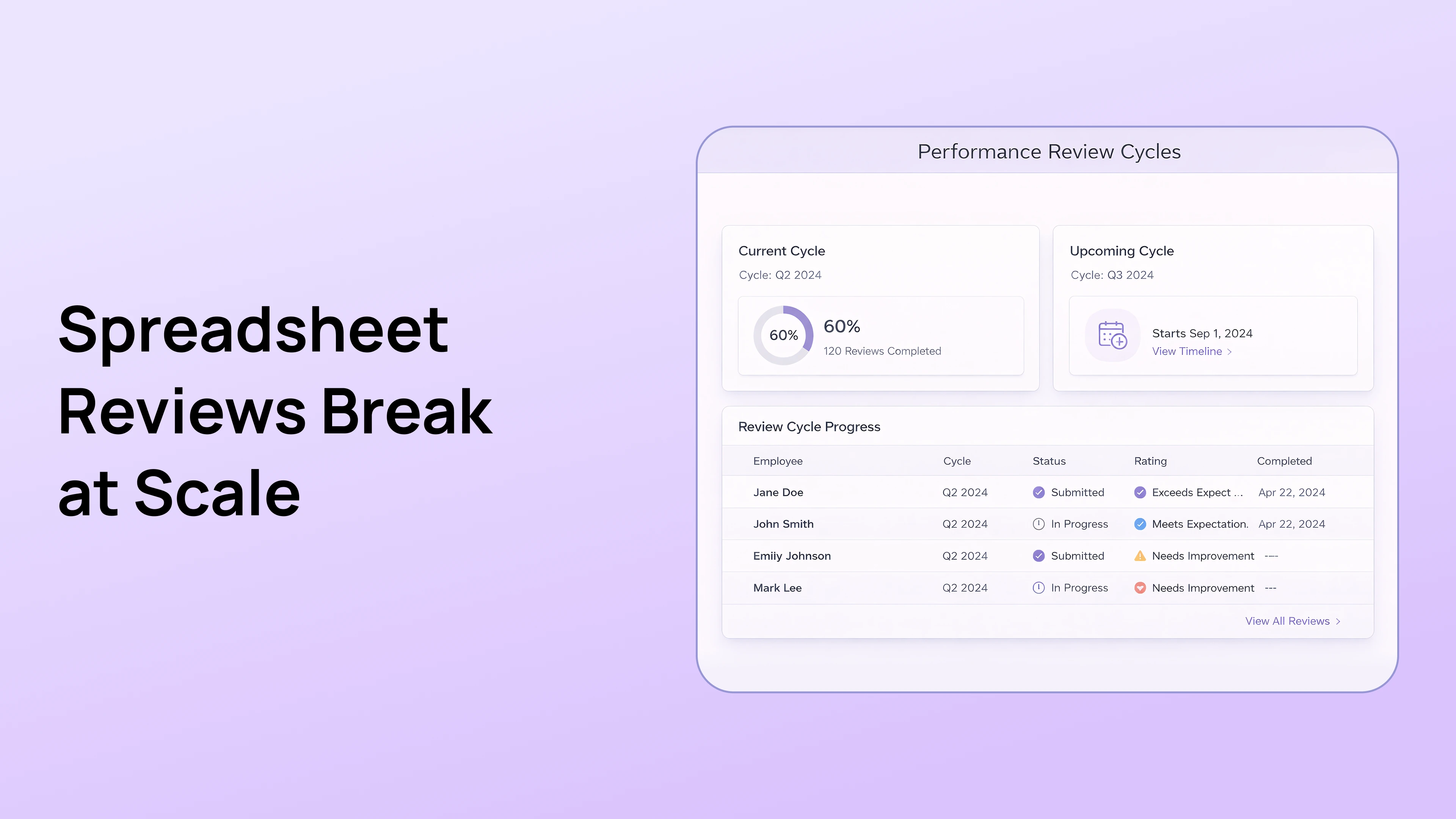
Table of Contents

Quick Takeaways: Spreadsheet Reviews vs. Software
- Spreadsheets are suitable while the process remains simple, controlled, and easy to report.
- The need to switch is driven by workflow complexity, permissions, fragmented evidence, calibration, and administrative burden, not a fixed headcount.
- Software should connect assignments, reminders, evidence, ratings, calibration, reporting, and development follow-up.
- Automating a weak review design will not fix unclear expectations or poor manager practices.
Spreadsheets can support a simple performance review process when the team is small, the review is limited, and one HR owner can manage access, reminders, consolidation, and follow-up. The problem begins when the process becomes difficult to control, not when the organization reaches a universal employee-count threshold.
Performance review software becomes useful when manual coordination, fragmented evidence, permissions, version control, reporting, calibration, or development follow-up consume more effort than the spreadsheet saves.
This guide compares spreadsheet performance reviews with a connected performance management platform, explains the warning signs that indicate a change is needed, and provides a practical migration plan.
When Spreadsheets Are Still a Reasonable Choice
A spreadsheet or shared document may be sufficient when:
- The organization is running an early or limited review cycle
- The number of reviewers and approval steps is small
- The review does not contain complex confidential inputs
- HR can manage permissions and deadlines reliably
- Ratings do not require cross-manager calibration
- The organization does not need connected goals, check-ins, feedback, or development records
- Reporting requirements are simple
A manual process is not automatically poor. It becomes a problem when the organization can no longer operate it consistently or protect the information appropriately.
Why Spreadsheet Review Processes Become Difficult to Scale
Version control
Review templates may be copied, renamed, emailed, or stored in multiple folders. HR can spend substantial time confirming which file is current and whether the manager, employee, and approver are working from the same record.
Permissions and confidentiality
Performance records may contain ratings, peer feedback, development information, and sensitive manager notes. Shared folders and links require careful permission management. Access should be limited to people with an appropriate role in the process.
Manual reminders and completion tracking
HR often maintains a separate tracker for self-reviews, manager reviews, approvals, meetings, and acknowledgments. The tracker becomes another file that must be updated and reconciled.
Automated performance reminders can reduce repeated manual follow-up while giving HR a current view of incomplete tasks.
Disconnected evidence
Goals may be in one spreadsheet, check-in notes in another tool, peer feedback in email, and the final review in a document. Managers then reconstruct the performance period from incomplete sources.
A connected goal management system and documented 1-on-1 check-ins can provide context before the review is written.
Manual reporting and calibration
Comparing rating distributions across managers may require exporting, cleaning, joining, and formatting multiple files. Every manual transformation creates an opportunity for inconsistent formulas or outdated copies.
Built-in performance calibration and reporting and analytics can keep the review record and the comparison view connected.
Weak follow-through
A spreadsheet review may be completed and then stored without connecting development actions to goals, check-ins, recognition, or a formal support process. The review becomes an archive instead of the start of the next cycle.
Spreadsheet Reviews vs. Performance Review Software
| Area | Spreadsheet process | Connected software |
|---|---|---|
| Templates | Copied and maintained manually | Configured and reused through controlled workflows |
| Assignments | Managed through lists, email, and folders | Assigned by employee, manager, role, or cycle |
| Reminders | Sent and tracked manually | Scheduled automatically with completion visibility |
| Evidence | Collected from separate files and tools | Can connect goals, check-ins, feedback, and reviews |
| Permissions | Dependent on file and folder settings | Role-based access can be built into the workflow |
| Calibration | Requires manual consolidation | Ratings and supporting information can remain connected |
| Reporting | Built with formulas and exports | Dashboards and reports update from the workflow |
| Development | Tracked separately | Can connect review outcomes to development plans and goals |
Signs It Is Time to Replace Spreadsheet Reviews
- HR cannot confirm the current version. Multiple copies regularly create confusion or rework.
- Permissions are difficult to manage. The process depends on broad folder access or manual link sharing.
- Review completion requires repeated chasing. HR spends significant time checking status and sending reminders.
- Managers cannot see relevant evidence. Goals, feedback, and check-ins are fragmented across tools.
- Ratings need calibration. HR must compare standards across multiple managers or departments.
- Reporting is slow or unreliable. Every question requires a new consolidation exercise.
- The review does not lead to action. Development goals and support commitments disappear after the meeting.
- Changes are difficult to trace. HR cannot easily identify the current approved assessment or reason for a change.
- The process cannot support different populations. New hires, managers, leaders, or business units need different workflows.
- The next cycle repeats the same administrative problems. Manual work continues even after templates and instructions are improved.
The right time to switch depends on process complexity, risk, and administrative burden rather than a fixed headcount.
What Automated Performance Reviews Should Include
Replacing a spreadsheet with a digital form is not enough. A useful automated process should support:
- Reusable review templates
- Self, manager, peer, and approval assignments
- Cycle dates and reminders
- Role-based access
- Goal and evidence visibility
- Rating scales and required comments
- Completion dashboards
- Calibration preparation
- Approved rating changes
- Employee delivery and acknowledgment workflows
- Development and follow-up actions
- Appropriate exports and retention controls
The performance review automation guide explains how to design these steps.
What Software Does Not Fix Automatically
Software cannot correct:
- Unclear role expectations
- Poorly written review questions
- A rating scale managers do not understand
- Important feedback delivered too late
- Managers who do not gather evidence
- Inappropriate or inconsistent process decisions
- A lack of development follow-through
Automation makes a process more repeatable. It can also repeat a weak process more efficiently. Review the process before configuring the system.
Security and Access Questions to Ask
- Can access be limited by role, team, and workflow stage?
- Can peer feedback visibility be configured?
- How are exports, attachments, and deleted records handled?
- Can HR review activity and approved changes?
- What authentication and access-control options are available?
- How does the vendor handle data retention and customer requests?
- Which integrations can read or write performance data?
Review the vendor's security information and verify the controls required by the organization. Cloud software is not automatically safer than a spreadsheet; safety depends on the implementation, permissions, vendor controls, and user behavior.
How to Migrate From Spreadsheets to Review Software
1. Map the current process
Document every template, owner, approval, deadline, reminder, report, and follow-up step. Identify which parts add value and which exist only because of the spreadsheet.
2. Clean the employee and reporting data
Confirm employee status, manager relationships, departments, locations, and review eligibility before importing or integrating data.
3. Simplify the review design
Remove duplicate questions, unnecessary approval layers, and fields that are never used. The employee performance review guide explains the essential sections.
4. Configure permissions and visibility
Define what employees, managers, peers, HR, and executives can see at each stage.
5. Pilot the workflow
Run a limited test with representative roles. Check assignments, reminders, mobile use, visibility, reporting, and the employee experience.
6. Train managers on the process
Training should cover evidence, rating standards, written feedback, meeting expectations, and system steps. Do not limit training to where users click.
7. Launch and monitor
Track completion, questions, missing evidence, support requests, and exceptions in real time.
8. Review the first cycle
Gather feedback and update the process before the next cycle. The rapid performance review launch guide provides a focused implementation sequence.
How to Estimate the Business Case
Use the organization's actual process data rather than generic savings claims. Estimate:
- HR hours spent creating, assigning, chasing, consolidating, and reporting
- Manager time spent locating evidence and completing forms
- Time required to prepare calibration
- Number of access or version-control incidents
- Cost of maintaining custom spreadsheets or scripts
- Time required to create development follow-up
- Software subscription, implementation, training, and support costs
The business case should also consider process quality, access control, employee experience, and decision visibility, not only labor savings.
Build a Review Process That Can Grow
PerformSpark connects performance reviews with goals, check-ins, feedback, calibration, individual development plans, and reporting. HR can automate the workflow without separating the review from the performance record.
Explore PerformSpark pricing or book a personalized demo to compare the platform with your current spreadsheet process.




.svg)

.svg)
.svg)